
Home Energy Monitor Setup Checklist Before Installing Solar Storage
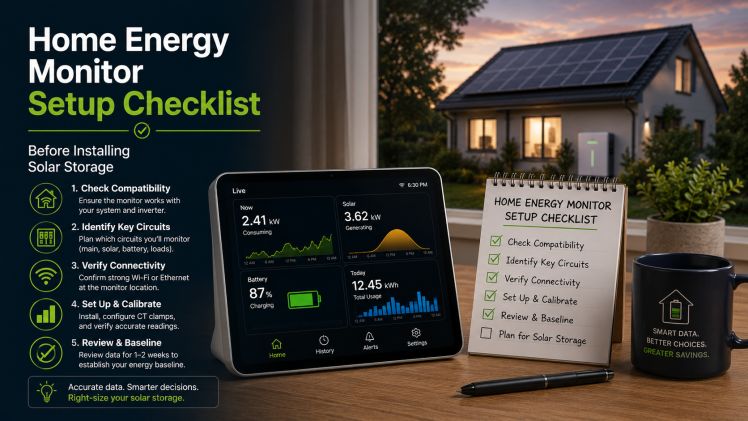
The best time to understand a home’s electrical habits is before the solar battery is installed. After the crew arrives, decisions about backup circuits, battery size, EV charging, and smart load control can become harder to change. A home energy monitor helps turn those decisions into a checklist instead of a guess.
Solar storage means a battery is paired with a solar system so electricity can be stored for later use. That may mean using solar after sunset, keeping essential loads alive during an outage, or reducing grid imports during expensive hours.
Watch a Normal Week First
A single day of data can be misleading. A normal week shows weekday routines, weekend laundry, EV charging patterns, and HVAC behavior. If possible, the homeowner should also look at a hot day, a cold day, and a day when everyone is home.
The U.S. Department of Energy notes that whole-house energy monitors can provide more detailed information about energy use, depending on the system. That detail is useful because storage design depends on timing as much as total kWh.
A home planning a home solar and storage system should use monitoring to answer where power goes today and where it may go after electrification.
Decide Which Loads Deserve Backup
Not every circuit needs backup. Refrigeration, internet, lighting, medical equipment, and garage access may be essential. A clothes dryer, oven, or large HVAC load may be optional unless the system is sized for it. A monitor can show how much each choice affects runtime.
Backup planning also needs power output, not only energy capacity. A battery may have enough kWh to run several loads over time but not enough output to start all of them at once. That distinction should be discussed before the final design.
Include the Next Five Years
Solar storage is not installed for yesterday’s house. It should fit the home as it is likely to become. If an EV, heat pump, electric water heater, or induction range is planned, the monitor can help show how much space is left in the current load profile.
Berkeley Lab’s Tracking the Sun research has shown rising battery attachment in some residential solar markets as rate structures change. That trend does not mean every home needs the same battery. It means homeowners need clearer reasons for storage, whether resilience, self-consumption, or rate optimization.
For households trying to connect those choices, the Sigenergy home energy solution is a useful reference point because it frames solar, storage, EV charging, and control as one home energy system.
It is also worth collecting a few non-energy details during the monitoring period. Which circuits feed the router, refrigerator, garage door, and home office? Which appliances share a circuit? Which loads are acceptable to pause during an outage? These answers help translate energy data into a backup design that people can actually live with.
The homeowner should save screenshots or exported usage summaries before the site visit. That gives the installer a more realistic view than a single annual bill. The bill shows the monthly total. The monitor shows whether the house has a manageable evening peak, a heavy overnight baseload, or a flexible load that could move into the solar window.
A monitor cannot replace a proper design, but it can make the design conversation much sharper.