
Coins To Cash And Accessibility: Expanding Crypto Use Through ATMs
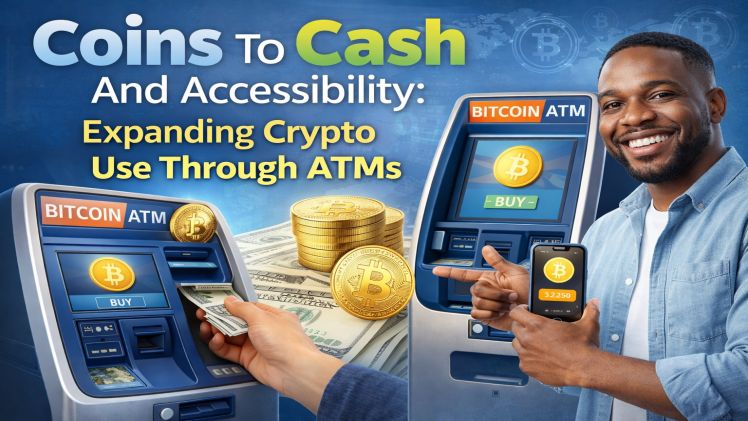
You’re grabbing a drink at a convenience store.
Nothing unusual. Quick stop. In and out.
Then you notice a machine glowing quietly near the entrance. Someone steps up, scans their phone, feeds in a few bills, taps the screen—and their phone buzzes a moment later.
Transaction complete.
You pause.
Wait… did that machine just turn cash into cryptocurrency?
Welcome to the quietly growing world of the Bitcoin ATM—a surprisingly simple tool that’s helping more people step into digital finance without complicated apps, trading platforms, or traditional banking hurdles.
And honestly, that simplicity might be the most important part.
Crypto’s Biggest Problem: It Looked Too Complicated
For years, cryptocurrency had a branding problem.
Not the technology—the onboarding.
Think about the typical entry process: create an exchange account, upload identification, connect a bank account, learn trading interfaces that look suspiciously like airline cockpit dashboards.
For someone who’s just curious about crypto, that’s… a lot.
Enter the Bitcoin ATM.
Instead of navigating multiple apps and financial tools, users interact with something familiar: a physical machine that accepts cash and sends digital currency to a wallet.
Scan. Insert. Confirm.
Short process. Low intimidation factor.
Sometimes accessibility is less about new technology and more about removing friction.
From Coins to Cash to Crypto
One of the biggest barriers to digital finance has always been the “on-ramp”—the moment when traditional money turns into cryptocurrency.
Bitcoin ATMs simplify that step dramatically.
You insert cash. The machine calculates the equivalent cryptocurrency amount based on current market prices. After confirmation, the funds are sent directly to your wallet.
That’s the core idea behind coins to cash systems: turning physical currency into blockchain-based assets in just a few minutes.
Under the hood, there’s a fair amount happening—market pricing, wallet verification, blockchain transactions.
But the user experience?
Refreshingly simple.
And simplicity tends to spread.
A Financial Option Beyond Banks
Here’s something worth pausing on.
Not everyone has easy access to traditional banking.
Some people live in areas where banks are scarce. Others face documentation requirements or account restrictions that make opening or maintaining accounts difficult. Even in developed economies, millions of people remain underbanked.
A Bitcoin ATM doesn’t solve every financial challenge—but it does offer another pathway.
Because these machines operate with cash transactions, they allow users to connect directly with digital financial networks without requiring a traditional bank account.
That’s a meaningful shift.
When financial access expands, opportunities often follow.
First-Time Crypto, Without the Overwhelm
Another interesting role Bitcoin ATMs play?
Education.
Not the classroom kind. The hands-on kind.
For someone new to cryptocurrency, abstract ideas like “blockchain transactions” or “wallet addresses” can feel distant and confusing.
But when someone scans a QR code, inserts cash, and watches cryptocurrency appear in their wallet minutes later—suddenly the concept clicks.
It’s tangible.
Real.
Sometimes the fastest way to understand a technology is simply to use it.
Local Machines, Global Networks
Here’s the fascinating part.
That small machine sitting next to the snack aisle connects directly to a global financial network.
Cryptocurrency transactions move across decentralized blockchain systems maintained by thousands of computers worldwide. Once funds are sent, they can travel across borders without relying on traditional financial clearinghouses.
Bitcoin ATMs act as local gateways into that global infrastructure.
Your neighborhood convenience store becomes a doorway to a decentralized financial ecosystem.
Not bad for a machine sitting between the ATM and the ice freezer.
Final Thoughts: Accessibility Changes Everything
New technology often promises big change.
But real adoption usually happens through small improvements in accessibility.
The Bitcoin ATM is a perfect example. It takes something that once required technical knowledge and turns it into a familiar, physical experience: insert cash, scan a wallet, receive digital currency.
Simple.
Approachable.
Local.
And sometimes the most powerful financial innovation isn’t hidden in complex software—it’s quietly waiting in the corner of a neighborhood store, ready to turn coins and cash into a connection with the global blockchain economy.