
How Asian Fans Can Adapt to North American World Cup Kickoff Times
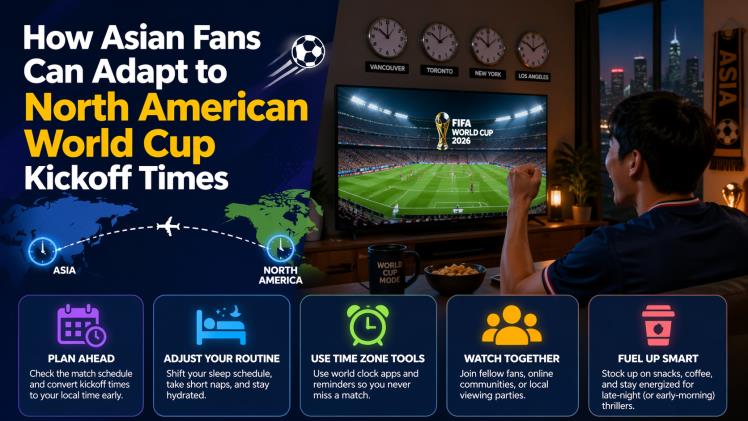
A World Cup hosted across the USA, Canada, and Mexico moves the football clock west, pushing many kickoffs into early-morning slots for Asian viewers. For fans who care about full-match viewing and tactical patterns, this time shift demands more than just staying up late—it requires rethinking how, when, and what you watch to keep your reading of matches sharp.
Why North American Time Zones Reshape the Viewing Experience
Because matches will be played across multiple North American time zones, typical local kickoffs such as early afternoon and evening translate to late night or early morning across much of Asia. This changes the basic viewing calculus: instead of fitting football around the day, many Asian fans will need to fit their day around football if they want to watch 90 minutes consistently.
The result is a trade-off between quantity and quality of viewing. Trying to see everything risks exhaustion and fragmented attention, which is disastrous if your goal is to follow pressing structures, build-up patterns, and in-game adjustments in real time. Choosing fewer matches but watching them with full focus becomes a more effective strategy for maintaining real tactical understanding.
How Match Timing Affects What You Actually Notice
When kickoffs fall at 2–4 a.m. local time, fatigue becomes a tactical filter. Viewers are more likely to mentally drift during slower phases, missing the small adjustments—like a full-back tucking inside or a pivot dropping between centre-backs—that explain why a later chance appears. Tired brains tend to fixate on obvious events such as shots and goals while ignoring the positional work that leads to them.
This has a direct impact on interpretation. If you only fully “wake up” for big moments, your post-match impression leans heavily on finishing variance instead of underlying structures. Over a tournament, this can make teams look more random than they are. To preserve accurate reading, Asian fans need to plan which parts of matches they must be freshest for, especially opening 20 minutes and post-adjustment phases after goals or major substitutions.
Choosing Which Matches to Watch Live and Which to Sacrifice
Given the time-zone gap, trying to watch every group-stage match live from Asia is likely to reduce, not increase, understanding. Instead, it helps to treat your schedule like a manager prioritising competitions: choose key fixtures where full-context tactical reading matters most.
Before deciding, consider a simple framework:
- Identify matches where both teams have distinct, contrasting styles (for example, high-press vs deep block) because these teach you the most about structures.
- Mark matches likely to decide group dynamics, where tactical risk-taking or caution will be most visible.
- De-prioritise games where one side is a heavy favourite with a straightforward approach and little variation in game-plan.
- Reserve your freshest viewing slots (earlier in the night) for teams you plan to follow throughout the tournament.
- For less critical matches, rely on extended highlights plus data (xG, shot maps) to reconstruct the story later.
This selective approach means you maintain a clear tactical picture of key teams rather than a blurry memory of everything. It mirrors how analysts work during congested schedules: depth for priority games, efficient summaries for the rest.
Using Live Viewing to Keep Your Tactical Eye Sharp
Even with awkward kickoff times, there is value in committing to some full live matches rather than relying entirely on replays. Watching live preserves uncertainty—you do not know the result—which keeps your attention on process instead of reverse-engineering from the scoreline.
For Asian fans, a practical pattern is to anchor your schedule around one match per day that you always watch live from start to finish, even if others are watched on delay. During these live games, watching in a mode similar to ดูบอลสด encourages you to track the full flow: rest defence shape when your team attacks, the spacing of the midfield line when possession is lost, and how pressing intensity changes between the first and last 15 minutes. This continuity keeps your reading muscles active, so delayed matches later still feel tactically “alive” when you watch them.
Structuring Sleep Around Key Kickoff Windows
From a physiological perspective, the main threat of North American timings is chronic partial sleep loss over a month-long tournament. That state makes it harder to track subtle off-ball positioning, which is exactly what serious viewers care about. Instead of sacrificing sleep randomly, it is more effective to structure it around specific match windows.
A simple, repeatable pattern might include:
- Shifting bedtime earlier on days with pre-dawn kickoffs, even by 60–90 minutes, to reduce sleep debt.
- Using short pre-match naps to create a sharper viewing window for the first half, when teams reveal initial game plans.
- Accepting that some second halves will be watched via replay after a sleep block, especially for lower-stakes fixtures.
- Grouping “all-in” nights (staying up for multiple games) around the most tactically rich days, such as final group matchdays.
- On rest days, deliberately avoiding football content before sleep to allow mental recovery.
Handled this way, time-zone stress becomes something you game-plan around, just as teams manage travel and recovery. Your goal is the same as theirs: enough freshness to execute the plan—in your case, the plan to read shape, spacing, and intensity accurately.
Using Replays and Data Without Losing the Live Feeling
Delayed viewing is inevitable for many Asian fans; the challenge is to use it without turning matches into mere highlight compilations. Full replays, especially those that preserve stadium sound and original commentary cadence, still allow you to follow pressing triggers, rest defence, and how chance quality develops over phases.
When you combine replays with data such as xG and shot maps, you can reconstruct the match flow with surprising precision. For example, if a team posts high xG from central zones but you notice those chances cluster after a specific substitution, you can retroactively identify the structural change that unlocked them. The key is to watch replays in “live mode”: no skipping ahead after goals, and pausing occasionally to check shape on defensive transitions, rather than fast-forwarding to the next shot.
How Time-Zone Constraints Change Your Tactical Learning Curve
Paradoxically, having to choose fewer live matches can make your tactical learning more focused. Instead of spreading attention thinly, you repeatedly observe the same teams at high engagement levels. Over a month, this repetition is what reveals patterns: how a side’s pressing height changes after qualification is secure, or how full-backs adjust positioning when facing different types of wingers.
The constraint also pushes you toward comparative analysis. When you cannot watch everything, you start to mentally cluster teams by key traits—pressing intensity, build-up risk, reliance on set pieces—and track how those clusters fare across similar conditions (for example, hot afternoon games vs cooler evening ones in different host cities). That comparative mindset is central to serious match reading and will carry over into club ดูบอลออนไลน์ฟรี goaldaddy once the World Cup ends.
Summary
A North America–hosted World Cup pushes most kickoffs into awkward hours for Asian fans, but this does not have to weaken your understanding of the tournament. By selectively choosing live matches, structuring sleep around key windows, and using full replays plus data to fill gaps, you can maintain a clear tactical picture without burning out. Treating your viewing schedule like a manager’s rotation plan keeps your focus sharp on the matches that matter most and preserves what really counts: your ability to read patterns, structures, and momentum in real time, regardless of where the tournament is played.