
How Instagram’s Algorithm Actually Treats Follower Count in 2026
So you’ve been staring at your Instagram follower count like it’s a stock ticker, haven’t you? Refreshing. Checking. Wondering if that number actually means anything beyond the dopamine hit when it ticks up.
Here’s the thing nobody wants to say out loud: follower count is kind of a vanity metric. But it’s also not. Which is the most annoying answer possible, I know.
Because yes, you can have 50K followers and zero engagement, zero sales, zero actual influence. We’ve all seen those accounts—beautiful grid, impressive number at the top, crickets in the comments. But you can also have 50K followers and a thriving business, an engaged community, and real opportunities sliding into your DMs weekly. The number itself doesn’t tell you which version you are.
The difference? Whether those followers are actually yours. Whether they showed up because they care about what you’re building, or because they got scooped up in some growth hack that promised you “10K followers in 10 days.” One of those paths leads somewhere. The other just leads to a bigger number and the same empty feeling.
So let’s talk about what follower count actually matters for, when it doesn’t, and how to think about growth without losing your mind or your integrity in the process.
What the Algorithm Actually Does with Follower Count
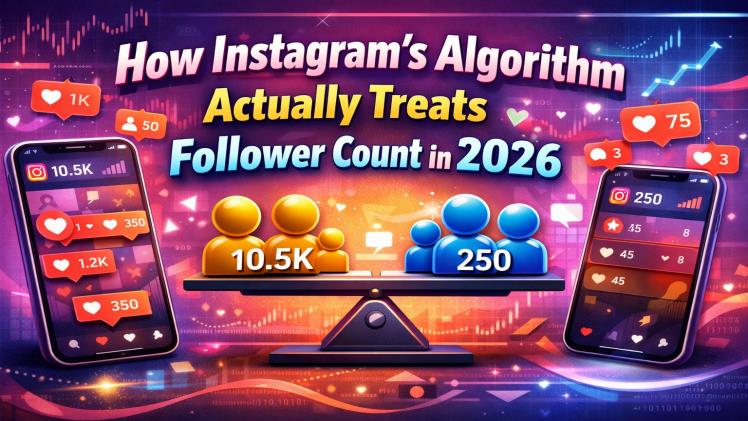
Instagram’s ranking algorithm doesn’t actually see “follower count” as a discrete input variable. What it processes is a constellation of engagement signals where your follower number functions as a denominator in multiple ratio calculations. The primary metric is engagement rate, reactions divided by reach over a rolling 90-day window. A profile with 10,000 followers getting 300 likes per post (3% engagement) will consistently outrank a profile with 100,000 followers getting 1,500 likes (1.5% engagement) in both Explore and recommended reels distribution.
The algorithm prioritizes what Instagram internally calls “relationship signals”: comment exchanges, profile visits, story replies, and saves. These carry exponentially more weight than passive likes. When you post, the system initially distributes to roughly 8-12% of your followers, specifically those with the strongest relationship signals from the past 30 days. If that cohort’s engagement rate exceeds your account’s historical baseline within the first 60-90 minutes, secondary distribution triggers. This pushes the content to followers with moderate relationship signals, then to non-followers via Explore if performance remains above threshold.
Here’s where follower count becomes a liability: every inactive or low-intent follower in your base dilutes that critical initial distribution pool. If you have 50,000 followers but only 4,000 are genuinely active, your content starts in a hole. The algorithm samples from the full follower base for that first wave—meaning 85-90% of your initial viewers are statistically unlikely to engage. You fail the first gate, secondary distribution never happens, and you’ve effectively suppressed your own reach. This is precisely why accounts that artificially inflate follower counts through any means—even best sites to buy Instagram followers, often see reach decline after acquisition rather than improve.
Content quality signals layer on top: completion rate for reels (watch time divided by reel length), dwell time for carousel posts, and forward shares via DM. Instagram’s 2026 ranking update increased the weight of “originality scores”, a computer vision model that detects reposted or aggregated content and systematically deprioritizes it. Original content from accounts with tight engagement ratios gets preferential placement in both feed and Reels tab. The follower count itself remains irrelevant except as it mathematically constrains or enables these core ranking mechanisms.
Why the Number Still Matters (Even If the Algorithm Ignores It)
Here’s the thing nobody wants to admit: humans are still making the real money decisions, not algorithms. Sure, Instagram’s AI decides what shows up in your feed, but when a brand manager is scrolling through potential partners at 11pm with a budget approval form open in another tab? They’re absolutely looking at that follower count first.
I’ve sat in those meetings. The conversation goes like this: “Okay, we have $5K for micro-influencers.” Someone pulls up a spreadsheet. The first filter? Follower count between 10K-50K. Nobody’s filtering by “engagement rate above 3.2%” or “audience authenticity score” because most brands don’t even have tools that measure that stuff. They’re using the number as a proxy for reach because it’s simple, it’s fast, and their boss understands it.
And look—monetization gates are real. Want to add links to your Stories? You need 10K followers. Trying to get into most affiliate networks? They’ve got minimum follower requirements printed right on the application page. These aren’t algorithm rules. They’re business rules created by humans who needed an easy threshold to separate serious creators from hobbyists. Fair? Maybe not. Reality? Absolutely.
There’s also the psychological weight of it. When someone lands on your profile and sees 47K followers, something shifts in their brain before they’ve read a single caption. Social proof isn’t a marketing theory, it’s evolutionary wiring. We look for signals that other humans have already vetted this thing, this person, this account. The number becomes a credibility shortcut, especially for people who don’t know you yet. Your existing followers might love you for your personality, but that stranger deciding whether to follow? They’re doing quick math on whether you’re worth their attention.
Engagement Rate Benchmarks By Tier
Instagram’s algorithm weights engagement differently depending on follower count, which creates tiered benchmark expectations. Nano-influencers (1K–10K followers) typically see engagement rates between 4–8%, while micro-influencers (10K–100K) average 2–5%. Macro-influencers (100K–1M) drop to 1.5–3%, and mega-tier accounts above 1M often land below 1.5%. The inverse relationship exists because larger audiences contain more passive followers and algorithmic distribution dilutes reach density.
Brands evaluate these benchmarks against campaign objectives. For conversion-focused partnerships, they’ll accept a nano-influencer’s 6% rate over a macro’s 2% because the absolute engagement volume matters less than audience quality and purchase intent signals. Media buyers typically disqualify accounts with rates below their tier baseline, it indicates bot inflation or content misalignment with the follower base.
The calculation itself is straightforward: total engagements (likes + comments + saves + shares) divided by follower count, expressed as a percentage. Stories complicate this metric since most analytics platforms don’t surface story engagement in aggregate calculations, though forward taps and exits carry algorithmic weight. Some brands now request “true engagement rate” using reach instead of follower count as the denominator, which accounts for Instagram’s sub-20% organic reach on feed posts.
Quick reference thresholds brands actually use:
Nano (1K–10K): 5%+ is solid, 7%+ is exceptional
Micro (10K–100K): 3%+ clears the bar, 4.5%+ stands out
Macro (100K–1M): 2%+ is acceptable, 3%+ is rare
Mega (1M+): 1%+ maintains viability, anything above 1.5% signals authentic audience retention
How Creators Actually Approach Growthblunt
Most creators treat Instagram growth like a second job. They post 4-7 times per week. They batch-create Reels on Sundays. They respond to DMs within an hour. They study analytics like traders study charts.
The tactics haven’t changed much. Carousels still outperform static posts. Reels with trending audio get pushed harder. Collaborations expose you to aligned audiences. Niche hashtags (10k-100k range) beat generic ones. Comment pods exist but nobody admits they’re in one.
Some creators accelerate at specific moments. Launch week for a course. Rebranding. Pitching a sponsor who checks follower count. That’s when a chunk quietly use best sites to buy Instagram followers to pad numbers before a deadline. It’s tactical, not their entire strategy. They’re not buying 50k followers and calling it growth, they’re adding 500-2k to cross a psychological threshold or look established enough to convert a business opportunity.
The work still matters more than the shortcut. A boosted follower count might open a door. It won’t keep you in the room if your content is weak or your engagement is dead. Growth services are a tool. Posting consistently is the foundation.
The Bottom Line
Look, follower count isn’t everything, but it’s not nothing either. You can have the best product, sharpest copy, and prettiest grid, but if your profile screams “12 followers,” people bounce. That’s just how brains work.
The move? Stop obsessing over the number itself. Build something people actually want to follow. Post stuff that makes them stop scrolling. Show up consistently enough that the algorithm remembers you exist. And yeah, if you need a little social proof to crack that first thousand and look legit? Do what you gotta do. Just don’t let it become the whole strategy.
Growth happens when you stop performing for the metric and start connecting with actual humans. Weird how that works.