
Game Theory Applications in Online Color Prediction Games
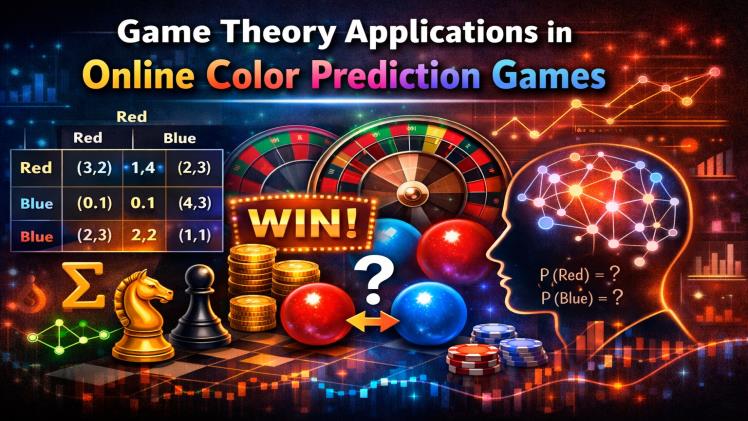
Game theory, a discipline rooted in mathematics and economics, studies strategic decision-making in competitive and cooperative environments. While traditionally applied to economics, politics, and military strategy, game theory has found new relevance in the digital gaming industry. Online color prediction games, which rely on forecasting outcomes based on color sequences, provide fertile ground for game theory applications. By examining player behavior, platform mechanics, and strategic interactions, game theory offers valuable insights into how these games function and how players can optimize their approaches.
Strategic Decision-Making in Prediction
At the core of game theory is the concept of rational decision-making. In color prediction games, players must decide which color to select based on probabilities, past outcomes, and perceived patterns. Although the results are often generated randomly, players attempt to apply logic and strategy to improve their chances. This mirrors the game theory principle of making choices under uncertainty, where individuals weigh risks and rewards before committing to a decision.
Probability and Expected Value
Game theory emphasizes the importance of probability and expected value in decision-making. In color prediction games, each choice carries a probability of success and a corresponding reward. Players who understand expected value can make more informed decisions, choosing options that maximize long-term gains rather than relying solely on instinct. This analytical approach reflects the mathematical foundation of game theory, where outcomes are evaluated not just by immediate success but by cumulative advantage over time.
Competitive Dynamics Among Players
Many color prediction platforms like jalwa game incorporate leaderboards, tournaments, or multiplayer features, introducing competitive dynamics. Game theory’s concept of zero-sum games becomes relevant here, as one player’s success often comes at the expense of another’s ranking. Players must anticipate the strategies of competitors, adjusting their own choices to maintain an advantage. This interplay of strategies highlights the relevance of Nash equilibrium, where players reach a state in which no one can improve their outcome by changing their strategy alone.
Psychological Factors and Behavioral Game Theory
Beyond mathematics, behavioral game theory examines how psychological factors influence decision-making. In color prediction games, players may be swayed by cognitive biases such as the gambler’s fallacy, believing that past outcomes influence future results. Platforms often design reward systems that exploit these biases, encouraging continued play. Understanding these psychological influences allows players to recognize when their decisions are driven by rational analysis versus emotional impulses, aligning with game theory’s broader exploration of human behavior.
Cooperation and Community Strategies
While prediction games are often competitive, some platforms encourage cooperative play through community events or group challenges. Game theory’s cooperative models apply here, as players may collaborate to achieve shared goals or maximize collective rewards. Cooperation introduces new strategic considerations, such as trust, reciprocity, and collective risk management. These dynamics demonstrate how game theory extends beyond individual decision-making to encompass group behavior.
Platform Mechanics and Strategic Design
From the perspective of developers, game theory informs the design of platform mechanics. Reward structures, difficulty levels, and progression systems are often crafted to balance engagement with sustainability. By applying game theory principles, platforms like jalwa game can predict how players will respond to incentives and adjust mechanics accordingly. This ensures that games remain engaging while maintaining fairness and profitability, reflecting the dual role of game theory in both player strategy and platform economics.
Future Applications of Game Theory
As online color prediction games evolve, game theory will continue to shape their development. Artificial intelligence may be used to simulate player strategies, creating adaptive platforms that respond dynamically to behavior. Blockchain technology could enhance transparency, allowing players to verify fairness while introducing new economic models. These innovations will expand the scope of game theory applications, reinforcing its relevance in the digital gaming landscape.
Conclusion
Game theory provides a powerful framework for understanding online color prediction games, illuminating the strategic, psychological, and economic dimensions of play. By analyzing probability, competition, cooperation, and platform design, players and developers alike can gain deeper insights into how these games operate. Ultimately, the application of game theory transforms color prediction games from simple entertainment into complex systems of strategy and interaction, highlighting their role in the broader digital gaming industry.